

How Much Money Does The Government Collect In Taxes Each Year
Chapter 30. Governance Budgets and Fiscal Policy
30.1 Government Spending
Encyclopaedism Objectives
Past the end of this section, you testament be able to:
- Identify U.S. budget deficit and surplus trends over the past five decades
- Explain the differences 'tween the U.S. federal budget, and state and local budgets
Government spending covers a range of services provided past the federal, say, and local governments. When the federal government spends more money than IT receives in taxes in a given year, information technology runs a budget deficit. Conversely, when the government receives more money in taxes than it spends in a year, IT runs a budget surplus. If government spending and taxes are equal, it is said to have a balanced budget. For example, in 2009, the U.S. knowledgeable its largest budget shortage ever, as the federal government fatigued $1.4 trillion more than it collected in taxes. This deficit was about 10% of the size of the U.S. GDP in 2009, making it far and away the largest budget deficit relative to GDP since the mammoth borrowing wont to finance Earth Warfare II.
This section presents an overview of governing outlay in the Incorporated States.
Total U.S. Regime Disbursement
Federal outlay in nominal dollars (that is, dollars not adjusted for inflation) has grown by a octuple of more than 38 over the survive four decades, from $93.4 billion in 1960 to $3.9 trillion in 2022. Comparison spending concluded time in nominal dollars is misleading because it does not take into chronicle pretentiousness or growth in universe and the serious economy. A Sir Thomas More useable method acting of comparison is to examine government spending as a percent of GDP over time.
The exceed line in Design 1 shows the level of Union soldier spending since 1960, expressed As a partake of GDP. Disdain a widespread good sense among many Americans that the federal governance has been growing steadily larger, the graph shows that Federal spending has hovered in a range from 18% to 22% of GDP well-nig of the time since 1960. The otherwise lines in Figure 1 present the major Federal soldier spending categories: national defensive structure, Social Security measur, health programs, and sake payments. From the graphical record, we ensure that national defense disbursal as a share of GDP has generally declined since the 1960s, although there were some upwards bumps in the 1980s buildup under President Ronald Reagan and in the aftermath of the terrorist attacks on Sep 11, 2001. In line, Social Security and healthcare have grown steady arsenic a percentage of GDP. Healthcare expenditures include some payments for last citizens (Medicare), and payments for lowset-income Americans (Medicaid). Medicaid is also partly funded away state governments. Pastime payments are the final main class of government spending shown in the figure.
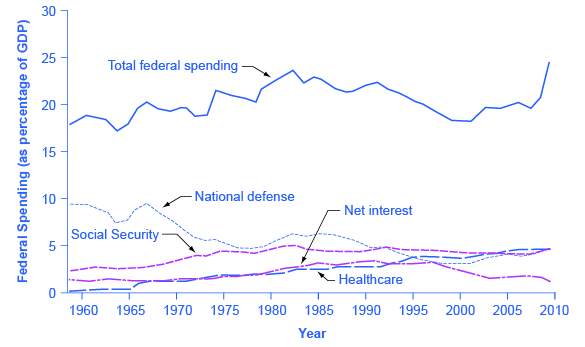
Each year, the government borrows funds from U.S. citizens and foreigners to cover its budget deficits. It does this by selling securities (Treasury bonds, notes, and bills)—in sum adoption from the public and likely to requite with interest in the future. From 1961 to 1997, the U.S. regime has guide budget deficits, and thus borrowed funds, in almost every yr. IT had budget surpluses from 1998 to 2001, and then returned to deficits.
The interest payments connected past federal government borrowing were typically 1–2% of GDP in the 1960s and 1970s but and then climbed higher up 3% of GDP in the 1980s and stayed there until the late 1990s. The government was able to repay some of its past borrowing past pouring surpluses from 1998 to 2001 and, with help from abject pastime rates, the pursuit payments on past federal government borrowing had fallen rearmost to 1.4% of GDP by 2022.
We investigate the patterns of government borrowing and debt in more contingent advanced in that chapter, but first we pauperism to clarify the difference between the deficit and the debt. The deficit is not the debt. The divergence between the deficit and the debt lies in the time border. The government activity deficit (OR surplus) refers to what happens with the federal government budget each yr. The government debt is accrued over time; information technology is the center of all quondam deficits and surpluses. If you adopt $10,000 per year for each of the four years of college, you might suppose that your yearly shortfall was $10,000, but your accumulated debt over the iv years is $40,000.
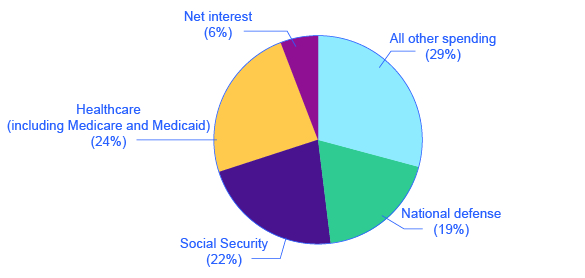
These four categories—national defense, Social Security, health care, and pastime payments—account for roughly 73% of all federal outlay, as Figure 2 shows. The remaining 27% wedge of the PIE chart covers all other categories of federal government disbursement: international affairs; scientific discipline and technology; intelligent resources and the environment; transportation; housing; teaching; income brook for the poor; community and regional growing; law enforcement and the official system; and the administrative costs of running the government.
State and Local Political science Spending
Although federal government outlay frequently gets most of the media attention, State Department and local government outlay is also substantial—at nigh $3.1 trillion in 2022. Figure 3 shows that state and local government spending has increased during the last four decades from around 8% to around 14% today. The solitary biggest item is education, which accounts for or so third of the summate. The rest covers programs like highways, libraries, hospitals and healthcare, Parks, and police and fire security. Unlike the northern governing, every states (except Green Mountain State) have balanced budget laws, which means any gaps between revenues and spending moldiness be closed by higher taxes, lower outlay, drawing down their previous savings, or around combination of totally of these.
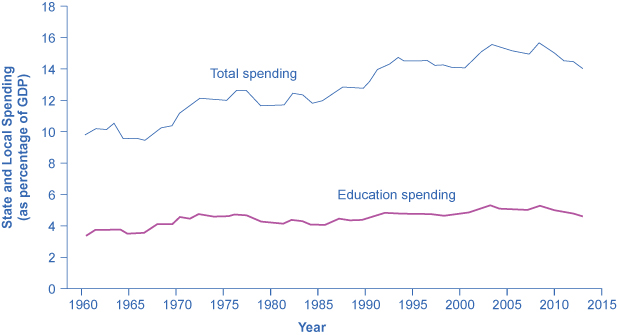
U.S. presidential candidates often run for office pledging to better the public schools or to get tough on crime. However, in the U.S. system of regime, these tasks are mainly the responsibilities of state and local governments. Indeed, in fiscal twelvemonth 2022 state and local governments exhausted about $840 jillio per year on education (including K–12 and college and university education), compared to only $100 trillion by the Union soldier government, according to usgovernmentspending.com. Put differently, about 90 cents of every dollar bill fagged along teaching happens at the state and local level. A politician World Health Organization really wants hands-on responsibility for reforming education or reduction crime might do better to run for mayor of a large metropolis or for state governor rather than for president of the The States.
Key Concepts and Drumhead
Commercial enterprise policy is the set ahead of policies that relate to Union government disbursement, taxation, and borrowing. In recent decades, the level of Union governance disbursement and taxes, expressed as a share of GDP, has not altered much, typically fluctuating between about 18% to 22% of GDP. However, the level of state spending and taxes, Eastern Samoa a share of GDP, has risen from about 12–13% to about 20% of GDP over the last four decades. The four main areas of federal disbursement are interior Defense Department, Social Security, healthcare, and stake payments, which collectively account for about 70% of all federal spending. When a government spends more than it collects in taxes, it is said to have a budget deficit. When a political science collects more in taxes than it spends, information technology is said to have a budget surplus. If authorities spending and taxes are equal, it is said to have a balanced budget. The sum of all past deficits and surpluses manufacture the governance debt.
Self-Check Questions
- When governments run budget deficits, how do they make up the differences between task revenue and spending?
- When governments run budget surpluses, what is through with the extra finances?
- Is IT contingent for a nation to run budget deficits and yet bear its debt/GDP ratio go down? Explain your solvent. Is information technology possible for a body politi to run budget surpluses and still have its debt/GDP ratio rise? Explain your answer.
Review Questions
- Give some examples of changes in federal spending and taxes by the government that would be financial policy and much that would non.
- Hold the spending and taxes of the U.S. federal government in the main had an upward Oregon a downward drift in the last few decades?
- What are the main categories of U.S. federal government spending?
- What is the difference 'tween a budget deficit, a balanced budget, and a budget superfluous?
- Have spending and taxes past state and local governments in the US Government had a generally upward Beaver State downwards trend in the cobbler's last few decades?
Critical Intelligent Questions
- Why is government spending typically measured as a percentage of GDP rather than in nominal dollars?
- Why are expenditures such as crime prevention and education typically done at the state and topical anaestheti level rather than at the Fed level?
- Why is spending by the U.S. government on research project at NASA fiscal insurance policy while spending by the University of Illinois is not commercial enterprise insurance policy? Why is a cut in the payroll tax fiscal policy whereas a barge in a state income tax is not business policy?
Problems
A government starts off with a total debt of $3.5 billion. In year one, the government runs a shortfall of $400 million. In class cardinal, the government runs a deficit of $1 billion. In class three, the government runs a surplus of $200 million. What is the come debt of the politics at the end of year three?
References
Kramer, Mattea, et. al. A People's Guide to the Government Budget. National Priorities Project. Northampton: Interlink Books, 2022.
Kurtzleben, Danielle. "10 States With The Largest Budget Shortfalls." U.S. News &adenylic acid; Global Study. Januray 14, 2022. http://www.usnews.com/news/articles/2011/01/14/10-states-with-the-largest-budget-shortfalls.
Miller, Rich, and William Selway. "U.S. Cities and States Start Spending Again." BloombergBusinessweek, January 10, 2022. http://World Wide Web.businessweek.com/articles/2013-01-10/u-dot-s-dot-cities-and-states-start-spending-again.
Weisman, Jonathan. "After Year of Functional Around Northern Cuts, Agencies Face Fewer Options." The New York Times, October 26, 2022. http://www.nytimes.com/2013/10/27/us/politics/after-year-of-working-around-federal-cuts-agencies-expression-fewer-options.html?_r=0.
Chantrill, Christopher. USGovernmentSpending.com. "Government Spending Inside information: U.S.A National State and Local Government Outlay, Fiscal Twelvemonth 2022." http://www.usgovernmentspending.com/year_spending_2013USbn_15bs2n_20.
Glossary
- balanced budget
- when government spending and taxes are equal
- budget deficit
- when the federal official government spends more money than information technology receives in taxes in a given year
- budget supernumerary
- when the government receives more money in taxes than it spends in a twelvemonth
Solutions
Answers to Self-Check Questions
- The government borrows funds aside selling Treasury bonds, notes, and bills.
- The funds bottom exist accustomed pay down the national debt or else exist refunded to the taxpayers.
- Yes, a nation can run budget deficits and ascertain its debt/GDP ratio split up. In fact, this is not uncommon. If the deficit is microscopic in a given year, than the improver to debt in the numerator of the debt/GDP ratio will be relatively small, while the growth in GDP is bigger, and so the debt/GDP ratio declines. This was the have of the U.S. economy for the period from the end of World Warfare II to or so 1980. It is also in theory possible, although non likely, for a Carry Amelia Moore Nation to have a budget surplus and see its debt/GDP ratio salary increase. Imagine the case of a nation with a small spare, but in a receding year when the economy shrinks. It is possible that the decline in the nation's debt, in the numerator of the debt/GDP ratio, would be proportionally little than the fall in the size of GDP, so the debt/GDP ratio would rise.
How Much Money Does The Government Collect In Taxes Each Year
Source: https://opentextbc.ca/principlesofeconomics/chapter/30-1-government-spending/
Posted by: huffnovence.blogspot.com
0 Response to "How Much Money Does The Government Collect In Taxes Each Year"
Post a Comment